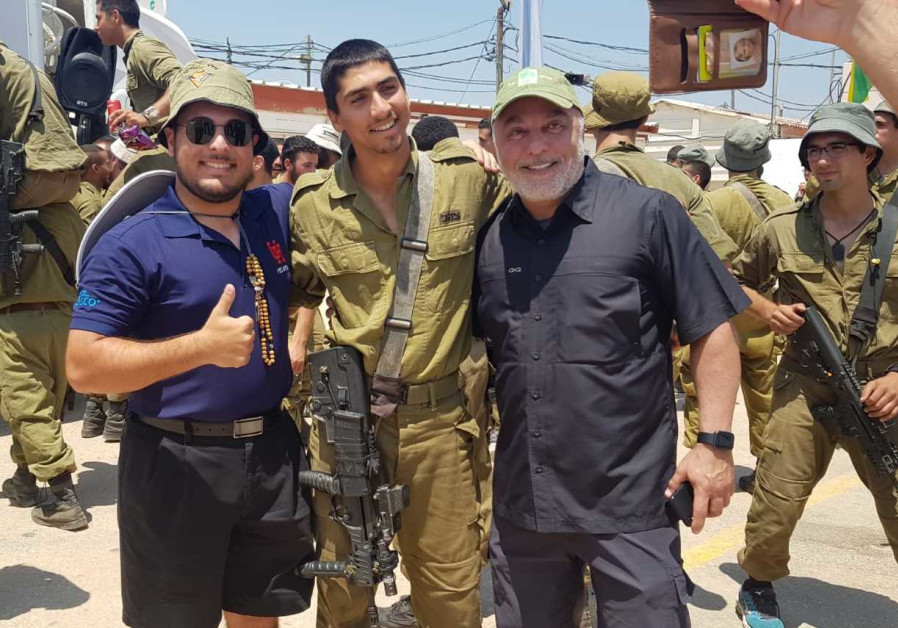
Atour Eyvazian spends time with IDF soldiers during his first-ever trip to Israel this week.. (photo credit: THE INTERNATIONAL FELLOWSHIP OF CHRISTIAN AND JEWS)
“I feel like I’m home in Israel,” said Atour Eyvazian, an Assyrian/Armenian Christian, who fled religious persecution in Iran.
Eyvazian lives in Texas, but his love for the State of Israel is deeply set. He is visiting the country for the first time this week.
Eyvazian sat down with The Jerusalem Post to share his story.
“I was walking around the market in Jerusalem [Mahaneh Yehuda] earlier and I was smelling the fruit, touching and looking at it, talking to the vendors, to the people – that is how it once was in Iran,” he said, implying that the diversity in Israel was what made him feel like he was back in his home country again.
It’s the first thing he recalled as he began to tell his story.
Eyvazian was born in Iran in 1965, the child of an Assyrian mother and Armenian-Christian father.
“Before the Iranian Revolution in 1979,” he recalled, “people were getting along... that’s what Iran was like, you could walk around freely, no one paid attention to who was Christian, or Jewish or Muslim. Life was good. But then, after the revolution, things became tough for Christians and Jews.
“The government changed and they divided the culture,” he continued, making it clear that he loves the people of Iran and that the problem with the country is its government, which he says is evil.
Following the revolution, if you were not Muslim, “you were seen as impure and spiritually dirty” – an infidel – “and if you went to the market and touched fruit, vegetables or items there, you were told you have to buy it” because it was contaminated.
It was when Eyvazian was 18 that he left Iran illegally.
“The year was 1984,” he told the Post. “I left through the mountains to Turkey. There were two guides who were to take me to Istanbul, but they left me at the border and robbed me of everything. They took everything – I was devastated.”
Asked why he left Iran, Eyvazian said that he was the only son in his family.
“My parents didn’t want me to go into the army,” he said, explaining that it was in the middle of the Iran-Iraq War and at that time anyone between the age of 10 or 11 and 50 could be used to fight in the military.
“And as someone from a different religion, you were seen as half human, you weren’t like them,” he said. “The minorities would be sent to war and they would come back dead – and they were shot in their backs, not the front.”
He explained that because he was 18, the perfect age for a soldier, it would not be possible for him to leave Iran legally.
“It took me almost a week to walk through the mountains to Turkey,” he said. “I had two $100 bills; my mother sewed one into each side on my pants so that if I got into trouble, I could buy my way out.”
Eyvazian also recalled the freezing conditions as he trekked through the mountains on his way to the border.
“When the two guides left me, I saw an old man walking and I spoke with him, he spoke back to me in Farsi and I asked if I was coming from Iran, I told him I was and that I was also looking for a bus.
“He pointed and said ‘just go straight,’” but little did Eyvazian know that he was being set up to be captured by the Turkish forces and incarcerated.
“He basically sold me out… I was captured in Baskale,” a town close to the Turkey-Iran border, he said. “Trucks with soldiers came and they let out the dogs – German Shepherds – I was surrounded.”
Over a two-week period in which he hiked through the mountains and was then being processed by Turkish authorities, he lost 20 kg.
After spending 40 days in prison, during which he was treated terribly and given almost no food, little access to a bathroom, and was hardly spoken to, he was released. He said he bribed his way out with the money his mother had sewn into his pants.
He showed the Post a large scar on his upper chest from a knife wound he received during his time in prison.
His parents – who were in their 50s, “so the government didn’t care for them” – left Iran after finding out that Eyvazian had been caught and arrested by the authorities.
“If a relative or child committed a crime, the Iranian regime would punish the family to make an example out of them,” he said.
After an arduous process and a six-month stay in Turkey, he finally made it to the United States, making a point to proudly remember the date: “November 4, 1984.”
He began working as a janitor and, for the first time in his life, he felt free.
“I was always high and smiling,” he recalled.
While working, he also got his bachelor's degree and an MBA, and despite his struggle, he now owns multiple businesses and restaurants in the United States, where he resides with his family.
But why does he love Israel?
His passion for the Jewish state began after he saw an infomercial on late night TV for the International Fellowship of Christians and Jews.
“Rabbi [Yechiel] Eckstein was on TV talking about bringing elderly Russian Jews to Israel,” he said, adding that this resonated with him and his own journey deeply as both his father and grandfather had been through hardships in Russia before going to Iran.
Eckstein founded the Fellowship, as it is now known, in 1983, with its main mission to promote understanding between Jews and Christians and to build broader support for Israel. Eckstein suddenly passed away earlier this year. The organization has been taken over by his daughter, Yael Eckstein.
“I’ve always had a soft heart for the Jews and Jewish culture, they have been wronged so many times and I want to do everything I can to right that wrong,” Eyvazian stressed.
The Iranian immigrant immediately decided to start donating whatever he could to the Fellowship, and over time kept count of how many people he had brought to Israel with the donations he made.
He later met with Eckstein and his relationship with the Fellowship and its rabbi blossomed.
“The Fellowship brings Jews and Christians together, Jews and Christians have so much in common... Christians, without Jews don’t understand their roots,” he said. The more I read books about what happened to Jews, their persecution and their history, the more I felt like that Israel is their home,” adding that he always questions, “what I can do to help them?”
He decided to take the trip with his family, because his children have gone through university and had a lot of questions about Israel.
“I wanted this trip to be educational for them, to break the stereotypes we all have,” he said, adding that the stereotype he’d heard about settlements was totally shattered during his visit.
“I thought when they spoke about settlements, that it was like an invasion – it meant people were being moved from their land and Jews were coming in," he said. "That’s not the case.
“Israel is a small country with a few million people and millions around them that don’t want it to exist,” he said, adding that seeing the Bible come to life and how this country really is the only democracy in the Middle East have been some of the highlights.
“Wow, there is so much freedom here, everyone is so friendly and from colorful backgrounds,” he said. “You see Orthodox Jews, and women in bikinis, men smoking – all at the same time, and everyone is the same. This is the true meaning of freedom.”
Asked about the boycott movement and those who call Israel an apartheid state, he said that “People who say that don’t know the truth. In this land, I have more freedom here than the place I was born. That tells you about democracy – anything bad toward Israel is evil.
"The right Muslims have in this country is something they wouldn’t have in their countries.
“I don’t understand how they can talk about boycotting,” he said, adding that he is also “puzzled about Jews who don’t support the State of Israel.”
He called on his fellow Christians to step up the fight in defending Israel.
“The fight for Israel is about good and evil," he said. "My message to Christian friends is that they need to step it up. The Christians need to support the Jews.”
Asked about the Iranian regime, he once again stressed that he worries and cares deeply about the Iranian people, but agrees with Prime Minister Benjamin Netanyahu’s sentiments about the government and that it has to be stopped.
“After 1979, they began to export not only oil and gas, but the revolution as well,” he said. “The Iranian government is a cancer, and if we don’t do something, it will grow, we need to get as many nation's together to stop them.”
He encouraged the Iranian people to do everything that they can to tell the international community about the situation in Iran, acknowledging that he knows how difficult such a thing is to do.
“I will stand by you, Israel,” he said. “I will share the messages and the truth about Israel.”
Join Jerusalem Post Premium Plus now for just $5 and upgrade your experience with an ads-free website and exclusive content. Click here>>
https://www.jpost.com/Israel-News/The-Iranian-refugee-who-loves-the-Jews-and-the-State-of-Israel-597064
2019-07-29 09:57:00Z
CAIiEKR0ZEW0vPyGF98-xGE3e7EqGAgEKg8IACoHCAowr9eeCTDYlm4whdicAQ
Bagikan Berita Ini


0 Response to "The Iranian refugee who loves the Jews and the State of Israel - The Jerusalem Post"
Post a Comment